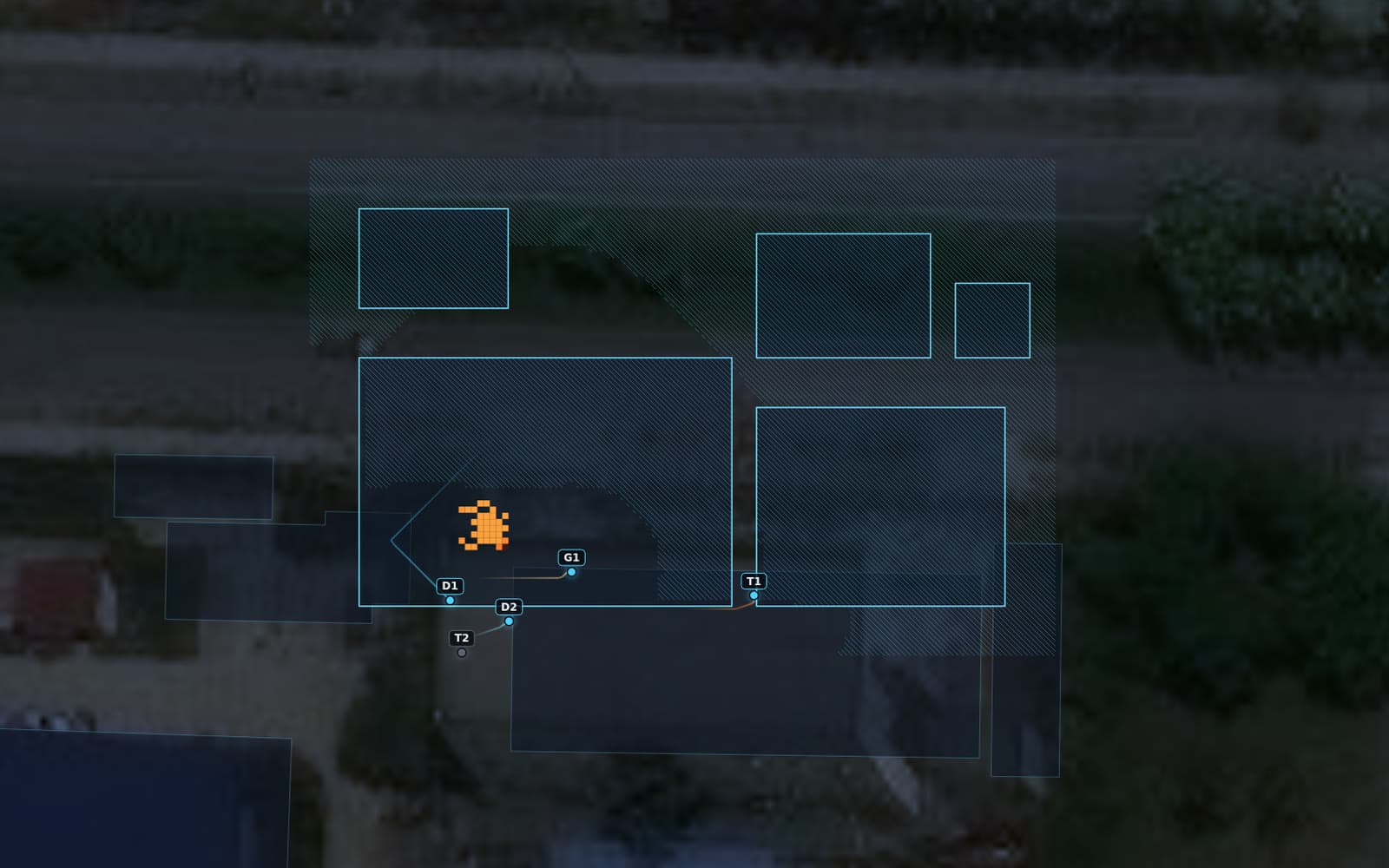
Belief-First Autonomy
Ask an autonomous system to act in an emergency and you've implicitly asked it to answer a harder question first: what does it actually know, as opposed to what it's guessing? Most systems blur that line without meaning to — a forecast quietly becomes a fact, a stale reading quietly stays trusted, an unexamined space quietly gets treated as safe. SentiaCore is built to never let that blur happen.
Three kinds of knowledge, kept separate
SentiaCore's picture of a scene — its belief — holds at least three distinct categories of information, and keeps them from leaking into each other:
- Confirmed. Something the team's own sensors have directly detected — a hotspot a thermal camera is reading right now, a person a detector has repeatedly tracked.
- Forecast. Something a physics model predicts will happen next, based on confirmed conditions — fire likely to spread to an adjacent cell, for instance.
- Unknown. Anywhere nobody has looked. Not "probably fine." Unknown.
A system that collapses these three into one undifferentiated "state of the world" is a system that will eventually treat a forecast as certain, or an unexamined room as cleared. SentiaCore's belief model is built explicitly to resist that collapse.
Confidence that ages
It's not enough to know whether something was ever confirmed — you have to know when. A reading from several minutes ago and a reading from right now are not the same claim, even if they're about the same place. SentiaCore's belief carries that freshness explicitly: confirmation decays, and a stale reading is never treated with the same weight as a fresh one. If nobody has looked at a space in a while, the system knows that too — and can route a robot back to check rather than quietly trusting the old answer.
Why this matters more at the edges
The cost of blurring confirmed and assumed scales with the stakes. In a space where a hazard reading is wrong, the error compounds — a robot or a person approaches a place the system assumed was safe. Belief-first autonomy is the discipline that keeps that assumption from ever forming in the first place: a space is unknown until something confirms otherwise, and that confirmation has to stay current to count.
A concrete example
Consider a life sign. Once a detector has confirmed a person is present and alive — after enough consistent sightings to rule out noise — that confirmation is not quietly walked back just because the system hasn't had a fresh look recently. It stays "alive" until there's actual evidence otherwise. But the inverse matters just as much: a robot is never allowed to act as though a person is confirmed safe to move unassisted unless that's actually been established. The belief model holds both directions of that line at once, and doesn't let either side slip.
What it means for a commander
A commander working from a belief-first system gets something rarer than a confident dashboard: an honest one. If the map says a zone is unconfirmed, it means exactly that — not "probably clear," not "we didn't get around to checking." That honesty is slower to produce a green light than a system willing to guess. We think that trade is the right one to make, every time, in a domain where the wrong guess doesn't come with a second chance.