Rehearsal Before Response
Every emergency response system eventually faces the same question: how do you know a plan is good before you commit a robot to it? The usual answer is experience — a trained human looks at the situation and makes a judgment call. SentiaCore's answer is different: it rehearses.
What rehearsal actually means
When SentiaCore's reasoning layer produces a leading candidate plan, it doesn't send it straight to a robot. It forks the living digital twin of the scene — the same belief state the team has built from its own sensors — and runs the plan forward inside that fork. Then it runs an alternative forward too, from the same starting point. Most often, that alternative is simply doing nothing: letting the fire spread, letting the robot hold position, letting the situation play out un-intervened.
The two outcomes are then compared directly. How much more area stays unburned under the proposed plan? How many more people does it reach? How much risk does it avoid, and what does it cost? A plan has to win that comparison — not just sound reasonable to whoever wrote it — before SentiaCore will let it move a robot.
This is the opposite of "trust the model." It's "trust the dry run."
Why baseline matters
A plan evaluated in isolation is nearly meaningless. "This plan reaches three people" sounds good until you ask what happens without it — if the baseline also reaches three people, the plan hasn't actually improved anything, no matter how sophisticated it sounds. SentiaCore's rehearsal always includes that baseline. A plan's score is a delta, not a standalone number — the comparison is the point, not the plan's coordinates on their own.
Rehearsal runs on real physics, not a toy
It would be easy to build a rehearsal step that runs on a simplified stand-in — enough to produce a number, not enough to mean anything. SentiaCore's rehearsal runs on the same physics model the team is actually operating against. If a plan only looks good against a simplified world, it doesn't survive contact with the real one, and the rehearsal step is designed to catch that before a robot does.
What this buys a commander
The practical effect is that a human commander isn't asked to approve a plan on faith. The plan card that reaches them already carries the result of a dry run: what it's expected to change, and how that compares to the alternative. Approval becomes a decision about a tested hypothesis, not a leap of faith in a black box.
This is also why rehearsal sits structurally before the safety gate in SentiaCore's loop, not instead of it. A plan can rehearse well and still get blocked by a hard safety rule — rehearsal tells you whether a plan is a good idea; the gate tells you whether it's an allowed one. Both have to say yes.
A concrete example
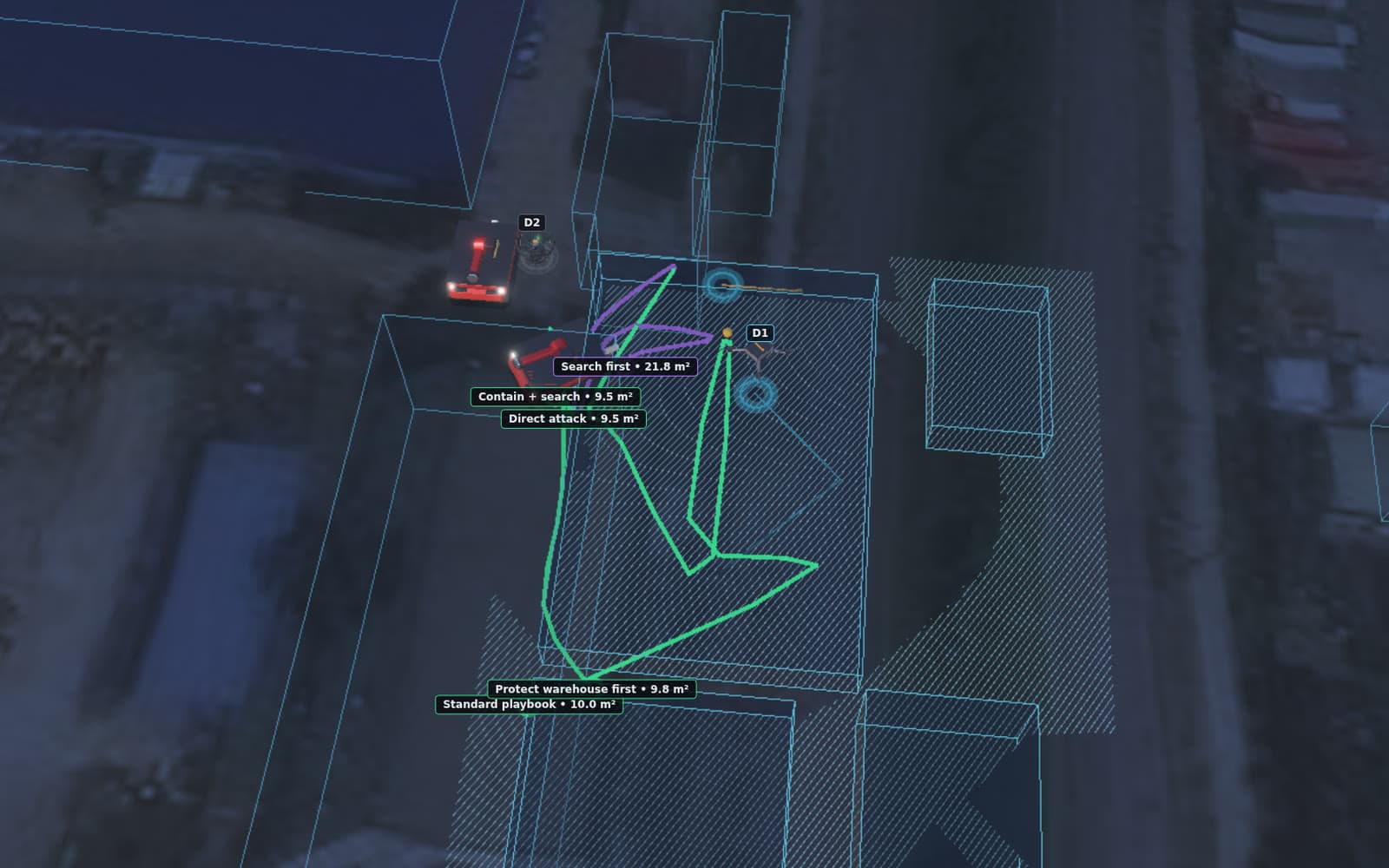
In one rehearsed scenario — a structure fire with robots already on scene — the system ran five candidate responses forward in parallel at the same decision point. The plan that held robots back to search for people before attacking the fire cost more than twice the burned area within three minutes of that decision, compared to attacking directly. Given two more minutes, that gap passed four times — not a number that leveled off, one that kept compounding. Plans that ran a protective water curtain alongside the attack cost about half again as much water at three minutes, and three times as much by five, a real trade-off created by the scene's own wind pattern, not a number anyone picked in advance.
What the same rehearsal did not show is just as important to say plainly: a safety metric tracking robots nearing dangerous heat came back identical — zero — across every plan tried, and rescue-speed differences at this horizon were small enough to be noise, not signal. Rehearsal isn't a tool for manufacturing a dramatic result; it's a tool for finding out, honestly, what differs and what doesn't. Here, the real difference was burned area and water, not an invented headline about which plan "saves more lives."
The discipline this enforces
Rehearsal-before-response is as much a discipline on how SentiaCore is built as it is a feature of what it does. It means a plan that only works in theory has nowhere to hide — it has to beat something concrete, every time, before it's trusted with a robot on a live scene. That's a higher bar than most autonomous systems hold themselves to, and it's the one we think the physical world actually demands.