The 4R Loop
It's tempting to describe an autonomous system as a pipeline: sense, then plan, then act, done. SentiaCore is built differently, on purpose — as a loop that never stops running, because an emergency doesn't hold still long enough for a one-shot pipeline to stay correct.
Four stages, one loop
Recreate. SentiaCore builds a living twin of the scene from what the team's own sensors have actually confirmed. This isn't a map drawn once at the start of a mission — it's continuously rebuilt as new sensor data arrives, and it explicitly separates what's confirmed from what's merely forecast from what's still unknown.
Reason. The team weighs its options as one mind. Every robot on the incident bids on the work in front of it based on its own real capability and position; doctrine and a language-driven planner contribute candidate plans; the strongest options rise for the next stage.
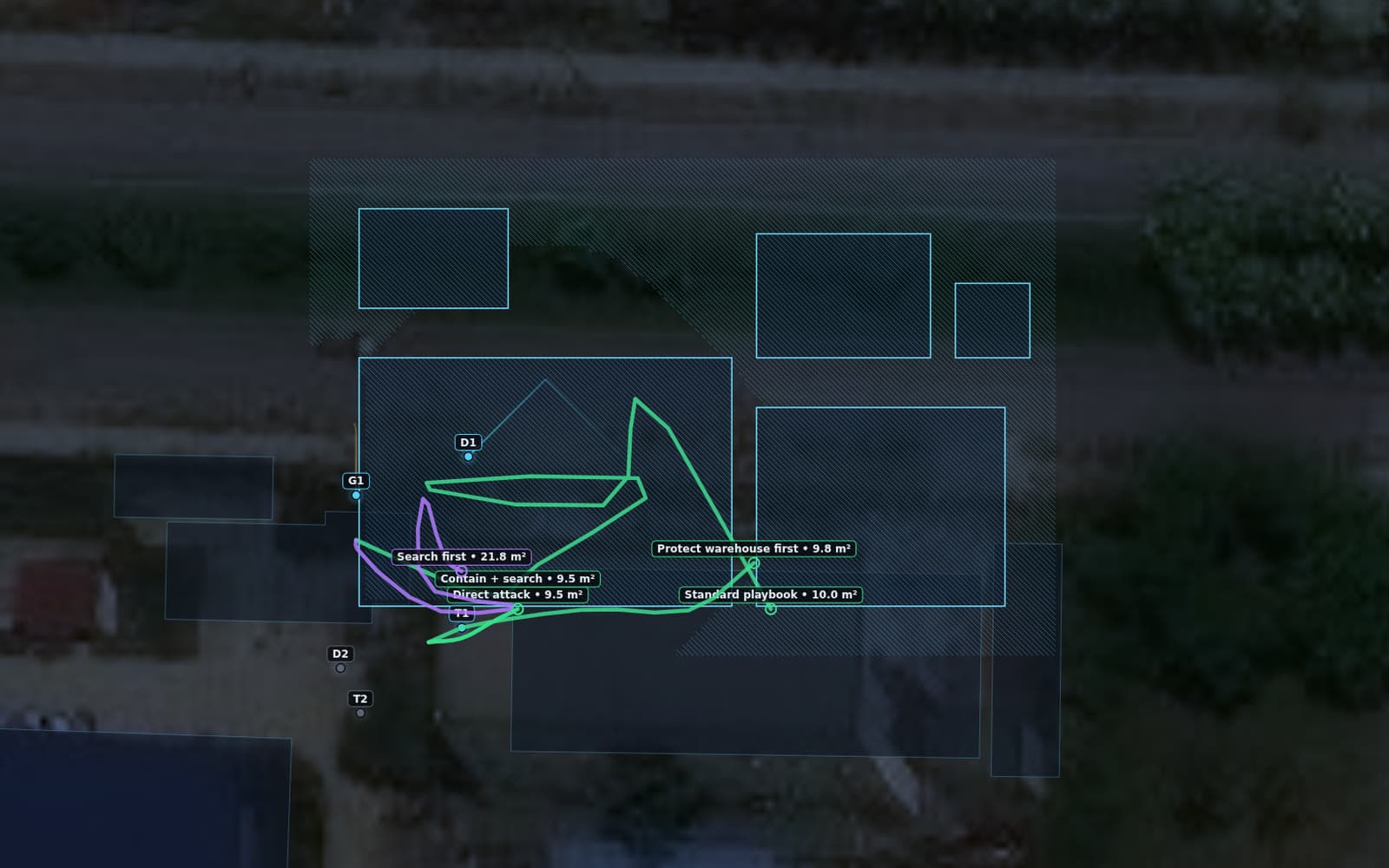
Rehearse. Before anything touches the real world, the leading plan is forked onto the twin and played forward — compared directly against an alternative, usually doing nothing. The comparison is what gets scored, not the plan in isolation.
Respond. The winning plan moves, through whichever robot bodies are actually on site, inside each robot's own reflexes and a safety shield a human can override at any instant.
Why a loop, not a pipeline
A pipeline implies an ending — perceive once, decide once, act once, done. That shape works for problems that hold still. A structure fire does not hold still. The scene fifteen seconds from now is not the scene the plan was built against, and a system that only recreates its picture of the world once per mission will eventually act on a world that's stopped existing.
Running Recreate, Reason, Rehearse, and Respond as a continuous loop — not once, but as many times a minute as the situation demands — is what keeps the plan in motion honest. By the time a robot acts, that action traces back to a belief state and a rehearsal result that are still current, not stale ones from the start of the incident.
The loop doesn't end at Respond
There's a fifth stage underneath the 4R loop that doesn't show up in the name but matters just as much: every mission becomes material for the next one. Missions get replayed, searched for the edge case that nearly broke a plan, and turned into new scenarios the team rehearses against before they happen for real. The 4R loop isn't just how a single incident gets handled — it's also how the system that handles the next incident gets better.
What this architecture buys
The practical payoff of treating this as one loop, rather than four separate features, is that none of the four stages can be trusted in isolation. A good plan built on a stale picture of the world is still a bad plan. A good rehearsal result for a plan that was never actually reasoned about carefully is a coincidence, not a guarantee. The loop's value is in the whole thing running together, continuously — which is also why it's the right shape to build a company's core technology around, rather than a single clever feature.